
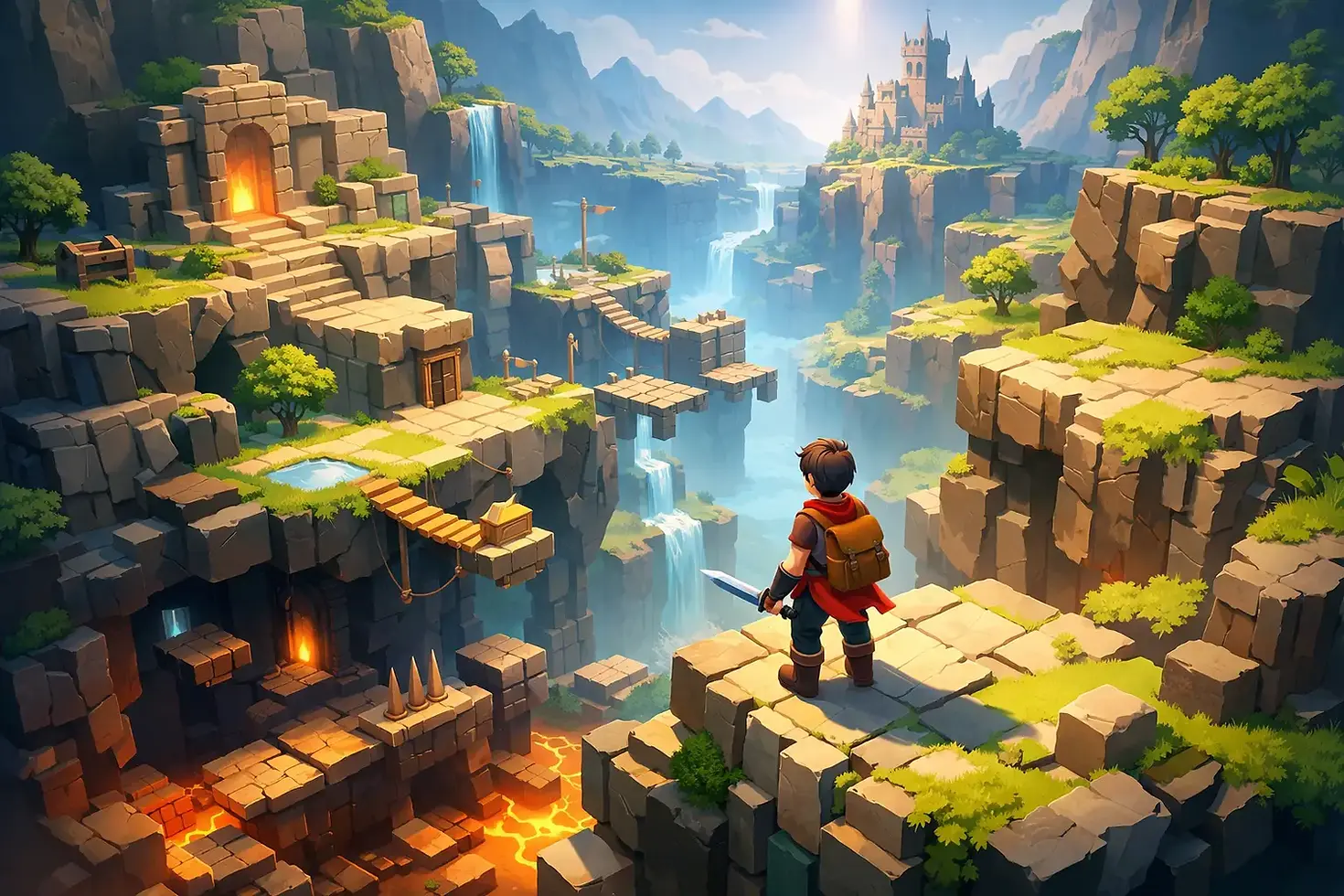
Why 2.5D Action Adventure Games Feel Huge
- aug. 5.
- 5 perc olvasás
A narrow bridge over a glowing abyss. A beast that fills half the screen. A hidden passage just beyond the torchlight. The best 2.5D action adventure games make these moments feel immediate because they place the player on a clear path through a world that still appears vast, dangerous, and full of secrets.
The format sits in a powerful middle ground. It combines the readable movement of a side-scroller with environments that have real depth, dramatic lighting, layered scenery, and cinematic scale. Players always understand where they can run, jump, aim, and fight. At the same time, the world can feel like it stretches far beyond the route in front of them.
What Makes 2.5D Action Adventure Games Different?
A 2.5D game usually plays along a primarily two-dimensional plane while using three-dimensional art, camera work, or level construction. Your character may travel left and right across a forest trail, castle corridor, or underground city, but the background can reveal distant mountains, moving machinery, towering ruins, and enemies entering from deeper in the scene.
That distinction matters in action-adventure design. Full 3D spaces give players freedom, but they can also create uncertainty. Where is the objective? Which ledge can be reached? Did the enemy attack from the side, behind, or somewhere off-camera? A 2.5D perspective answers those questions quickly, allowing the challenge to come from timing, tactics, and exploration rather than camera control.
It is not a lesser version of 3D. It is a deliberate frame for action. The player gets a strong view of every jump, projectile, and incoming strike, while artists and level designers use depth to build mood and anticipation.
Clear Movement Creates Better Combat
Great combat starts with information. Players need to read enemy tells, judge distance, and understand the consequence of their next move. In a 2.5D action adventure, that information is presented with unusual clarity.
A charging enemy has a readable lane of attack. An archer on a raised platform becomes an immediate priority. A collapsing floor or swinging trap is visible before it becomes a problem. This gives combat a sharp, responsive rhythm: move, evade, strike, use an ability, then reposition before the next threat closes in.
That clarity does not mean the combat has to be simple. A good game can layer in ranged weapons, magic, parries, aerial attacks, environmental hazards, companions, and upgrade choices without burying the player in visual noise. The best encounters begin with an understandable threat and gradually demand more precise decisions.
Boss battles benefit especially well from this approach. A huge creature can dominate the screen without making its attacks impossible to track. Phase changes are easy to stage. Weak points can be visible but hard to reach. When a player wins, it feels earned because the battle was readable enough to learn and demanding enough to master.
Depth Is More Than a Visual Effect
The “.5” in 2.5D is often associated with graphics, but it can shape the entire adventure. A layered world gives each location a stronger sense of place. Rain can fall in front of the camera while an ancient fortress rises behind the playable route. A distant battle can hint at a conflict the player has not reached yet. A village seen through cave openings can become a promise of safety after a difficult expedition.
This visual depth also supports storytelling without stopping the game. Instead of explaining every part of a kingdom, designers can show broken statues, abandoned mine carts, banners from a defeated army, or lights flickering in an unreachable tower. Players absorb the stakes while they keep moving.
For fantasy adventures, this is particularly useful. A dwarven city can feel monumental even when the player follows a carefully designed route through its halls. An enchanted forest can hold layers of branches, mist, and ancient structures, making every clearing feel like a discovery. The world has room to breathe, while the player’s next objective remains visible.
Exploration Works Best When Curiosity Has a Reward
Action without discovery can become repetitive. Exploration without direction can become tiring. 2.5D action adventure games can balance both by making detours clear and meaningful.
A cracked wall, a suspicious gap, a path beneath a moving platform, or a ledge visible in the background can invite experimentation. Players do not need a massive map to feel curious. They need signs that careful observation matters.
The reward should fit the risk. A short side route might contain currency or crafting material. A difficult platforming sequence could lead to a stronger weapon, a new ability, or a piece of lore that changes how players see the world. A hidden combat arena may offer a rare upgrade for those willing to face a tougher challenge.
There is a trade-off here. If every route is packed with rewards, exploration starts to feel mandatory and the main pace slows down. If secrets are too obscure or too weak, players stop looking. The strongest level design gives players choices while ensuring that the central path remains exciting on its own.
Progression Gives Every Fight a Purpose
The core actions in a great adventure should feel satisfying from the first encounter. A sword strike needs impact. An arrow needs a clean trajectory. A dodge needs to respond when the player commits. But long-term progression gives those actions more meaning.
New equipment can change a fighting style rather than merely increase a number. A heavier weapon may stagger armored enemies but leave the player exposed. A faster ranged option might reward accuracy and movement. An ability that opens sealed doors can also create new combat opportunities, turning exploration tools into part of the action loop.
This is where accessible design and skill-based play can work together. New players can depend on simple movement and reliable attacks. Experienced players can chase efficient combinations, hidden upgrades, challenge routes, and cleaner boss victories. The game welcomes a quick session, then gives determined players a reason to return stronger.
Why the Format Fits Modern Platforms
2.5D adventures translate naturally across mobile, PC, console, and VR-adjacent experiences because their central language is easy to read. On a phone, clear lanes and focused controls help players act with confidence. On a larger screen, detailed environments and animated set pieces gain room to impress. On a controller, the format supports precise movement, fast reactions, and satisfying button-driven combat.
The platform still changes the design priorities. Mobile players may value shorter checkpoints, straightforward controls, and meaningful progress in brief sessions. PC and console players may expect denser worlds, deeper challenge options, and more elaborate encounters. A strong cross-platform game respects those habits without losing the identity of its world.
That is one reason the format remains compelling for independent studios. It can deliver heroic scale without requiring a giant open world, provided the craft is there. Strong art direction makes the layers believable. Polished coding makes movement dependable. Thorough QA matters because a missed jump, an unclear collision, or a camera issue can break the trust that this perspective works so hard to build.
Upcoming adventures such as Narin - Secrets of Dwarvenia show why the format still has so much territory left to claim. A focused path through a dangerous fantasy realm can deliver exploration, combat, secrets, and cinematic stakes without asking players to spend hours navigating empty space.
When choosing your next adventure, look for the small signals: an enemy that demands better timing, a distant ledge that sparks a question, an upgrade that changes how you play, and a world that makes you want to see what waits beyond the next screen. That is where a 2.5D journey becomes more than a route forward - it becomes a place worth fighting through.


Hozzászólások